



Dr. Jiang Changchun
Chief Physician; Deputy Director, Department of Neurology; Director, Neurointervention Center, Baotou Central Hospital; Master’s Supervisor.
Dr. Jiang is a core member of Baotou’s “5512 Project” Innovation Team and a selected candidate for the city’s Distinguished Physician Program. He currently serves as:
Executive Member, Neurointervention Committee of the Chinese Stroke Association
Member, Neurointervention Professional Committee of the Chinese Medical Doctor Association
Member, Neurointervention Professional Committee of the Neurology Branch, Chinese Preventive Medicine Association
Vice Chairman, First Interventional Radiology Branch, Baotou Medical Association
Member, Neurology Branch, Baotou Medical Association
Dr. Jiang specializes in interventional treatment of cerebrovascular diseases. He was among the first in Inner Mongolia to carry out intracranial and extracranial stenting, aneurysm embolization, and endovascular therapy for acute ischemic stroke.
He has published numerous academic papers, 13 of which are indexed in SCI, and has received the Second Prize for Scientific and Technological Progress of Inner Mongolia.
Dr. Fan Yu
MD, Associate Chief Physician, Master’s Supervisor
Dr. Fan is a selected candidate of Baotou’s Distinguished Physician Program. He currently serves as:
• Member, Youth Committee of the Neurointervention Committee, Chinese Stroke Association
• Member, Emergency Intervention Group, Neurointervention Branch, Chinese Research Hospital Association
• Vice Chairman, Youth Committee of the Neurointervention Professional Committee, Inner Mongolia Medical Doctor Association
Dr. Fan specializes in interventional treatment of ischemic and hemorrhagic cerebrovascular diseases. He has undertaken several research projects, including those funded by the Inner Mongolia Natural Science Foundation, and has received the Second Prize for Scientific and Technological Progress of Inner Mongolia.
In recent years, he has published over 20 academic papers, including 5 indexed in SCI.
Patient: Male, 46 years old
Chief Complaint:
Speech difficulty, weakness of the left limbs, irritability, and generalized tremor for 2.5 hours.
Physical Examination:
The patient was irritable, had slurred speech, impaired leftward eye movement, right limb muscle strength grade 5, and uncooperative movement of the left limbs (in flexed posture). Muscle tone of the left limbs was markedly increased. Bilateral Babinski signs were negative.
NIHSS Score: 9
Past Medical History: None reported.
TCD: Lesion in the right internal carotid artery.
Diagnosis: Cerebral infarction due to occlusion of the right internal carotid artery.
Preoperative Imaging:
ASPECTS score: 10
Indications and Treatment Plan:
Treatment Strategy:
Primary approach: ADAPT (A Direct Aspiration First Pass Technique)
If necessary, stent retriever thrombectomy to be performed as adjunctive therapy.
Main interventional device selection during the procedure:
Postoperative Management:
Postoperative Follow-up:
Aspiration is one of the effective endovascular treatment methods for acute ischemic stroke (AIS), particularly suitable for embolic occlusions, as it improves the first-pass recanalization rate and reduces distal embolization.
The closer the diameter of the aspiration catheter matches the target thrombus or vessel diameter, the better the catheter–thrombus contact, resulting in higher aspiration efficiency. Therefore, whenever feasible, a larger-bore aspiration catheter should be used.
Conventionally, 088 aspiration catheters (outer diameter 8F) were considered unsuitable for advancement beyond the C2 segment of the internal carotid artery.
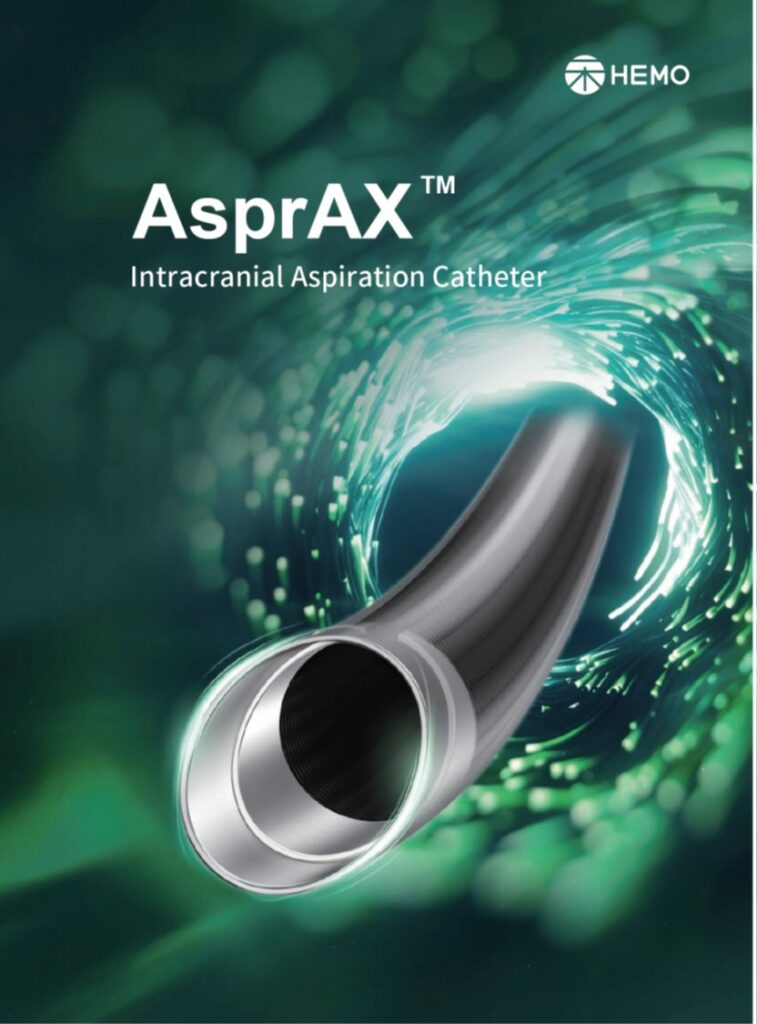
HEMO’s AsprAX 88 features a 15 cm soft distal segment with excellent trackability and compliance. With adequate proximal support, it can easily reach the proximal M1 segment, significantly enhancing aspiration efficiency.
The flat-tipped large-bore design of the HEMO aspiration catheter increases the contact area with the thrombus, resulting in approximately 15% greater aspiration force.
Its large lumen and optimized tip design enable effective removal of high thrombus burden occlusions.
Hemo Bioengineering Pte Ltd (referred to as “Hemo”) officially commenced operations in 2017. Hemo’s global headquarters is located in Singapore, with research and development centers in both Singapore and China. It collaborates with long-term partners in the United States to focus on new product design and keep abreast of cutting-edge global technologies.
Hemo is dedicated to integrating high-quality global research and development, production, clinical, and academic resources to provide innovative vascular and neurointerventional products for patients and medical professionals. It aims to offer comprehensive intervention solutions for cerebrovascular diseases, including ischemic stroke, hemorrhagic stroke, and intracranial vascular stenosis.

enquire@hemocorp.com
| Cookie | Duration | Description |
|---|---|---|
| cookielawinfo-checkbox-analytics | 11 months | This cookie is set by GDPR Cookie Consent plugin. The cookie is used to store the user consent for the cookies in the category "Analytics". |
| cookielawinfo-checkbox-functional | 11 months | The cookie is set by GDPR cookie consent to record the user consent for the cookies in the category "Functional". |
| cookielawinfo-checkbox-necessary | 11 months | This cookie is set by GDPR Cookie Consent plugin. The cookies is used to store the user consent for the cookies in the category "Necessary". |
| cookielawinfo-checkbox-others | 11 months | This cookie is set by GDPR Cookie Consent plugin. The cookie is used to store the user consent for the cookies in the category "Other. |
| cookielawinfo-checkbox-performance | 11 months | This cookie is set by GDPR Cookie Consent plugin. The cookie is used to store the user consent for the cookies in the category "Performance". |
| viewed_cookie_policy | 11 months | The cookie is set by the GDPR Cookie Consent plugin and is used to store whether or not user has consented to the use of cookies. It does not store any personal data. |
